
Doing something isn't the same as proving it worked.
Not everything you can count tells you that something changed.
Most annual reports, funding applications, and social media updates lead with a similar kind of figure: sessions delivered, people reached, items fixed. These are useful numbers, but on their own they only tell you that something happened, not whether it made a difference to anyone.
This is one of the first things I cover in the impact measurement training I deliver, because it's the distinction most reporting gets wrong. I use a simple hierarchy, where each level builds on the one before.
Metrics are the raw numbers behind an activity: sessions run, referrals received, resources produced.
Outputs are the immediate, tangible results: people who completed a programme, referrals followed up, resources distributed.
Outcomes are the actual difference made to the people involved: someone secures a job, a family's housing situation stabilises, a person feels more confident managing their finances.
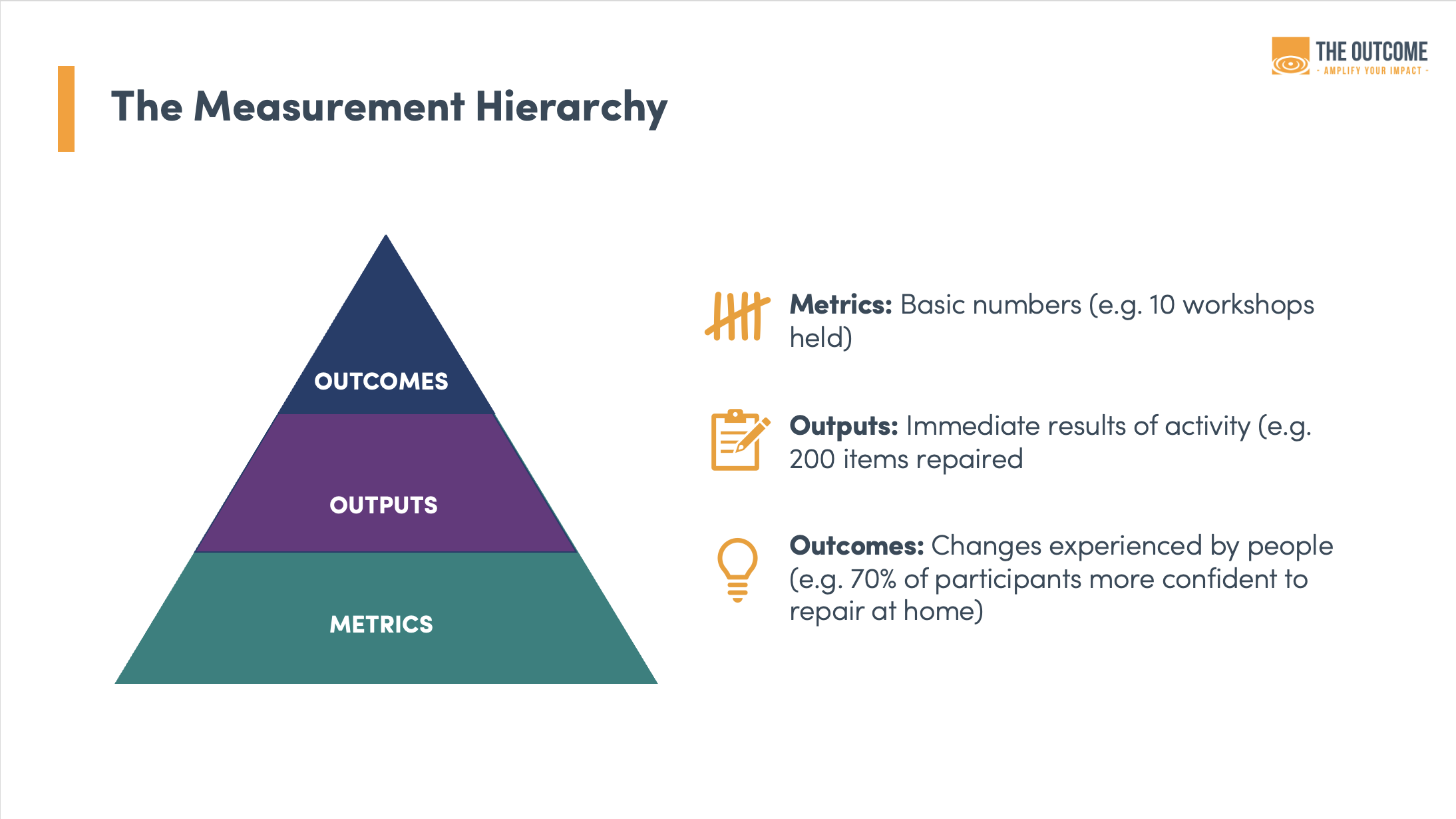
The same activity can be reported at any of these three levels, and the number you choose tells a very different story.
A jobs training programme could report the number of workshops delivered, or the number of people who completed the course, or that 60% of graduates were still in employment six months later.
A debt advice service could report the number of clients seen, or the number of debt management plans agreed, or that clients report feeling more in control of their finances a year on.
A youth mentoring programme could report the number of sessions held, or the number of young people matched with a mentor, or that participants report feeling more confident about the future.
Only the last one in each case tells you whether anything actually changed.
There's a practical reason metrics and outputs dominate; they're easier to get hold of. You already know how many sessions you ran and how many people completed a course, you don't need to ask anyone. Outcomes usually mean following up, sometimes weeks or months later, which takes more time and requires an organisation to have impact measurement activity integrated into its systems.
That's a real constraint, not a failure of will. But it's worth being honest about which level you're actually reporting at. A funder or board reading "45 people completed the course" may well assume that means something changed for them, when what you've actually shown is that an activity happened. These aren't the same claim. It's usually worth having at least one outcome-level indicator alongside the output numbers, even a simple one, so the report reflects what you can genuinely say happened.
If you're not sure which level your organisation is currently reporting at, this is exactly the kind of thing we help unpick — get in touch.